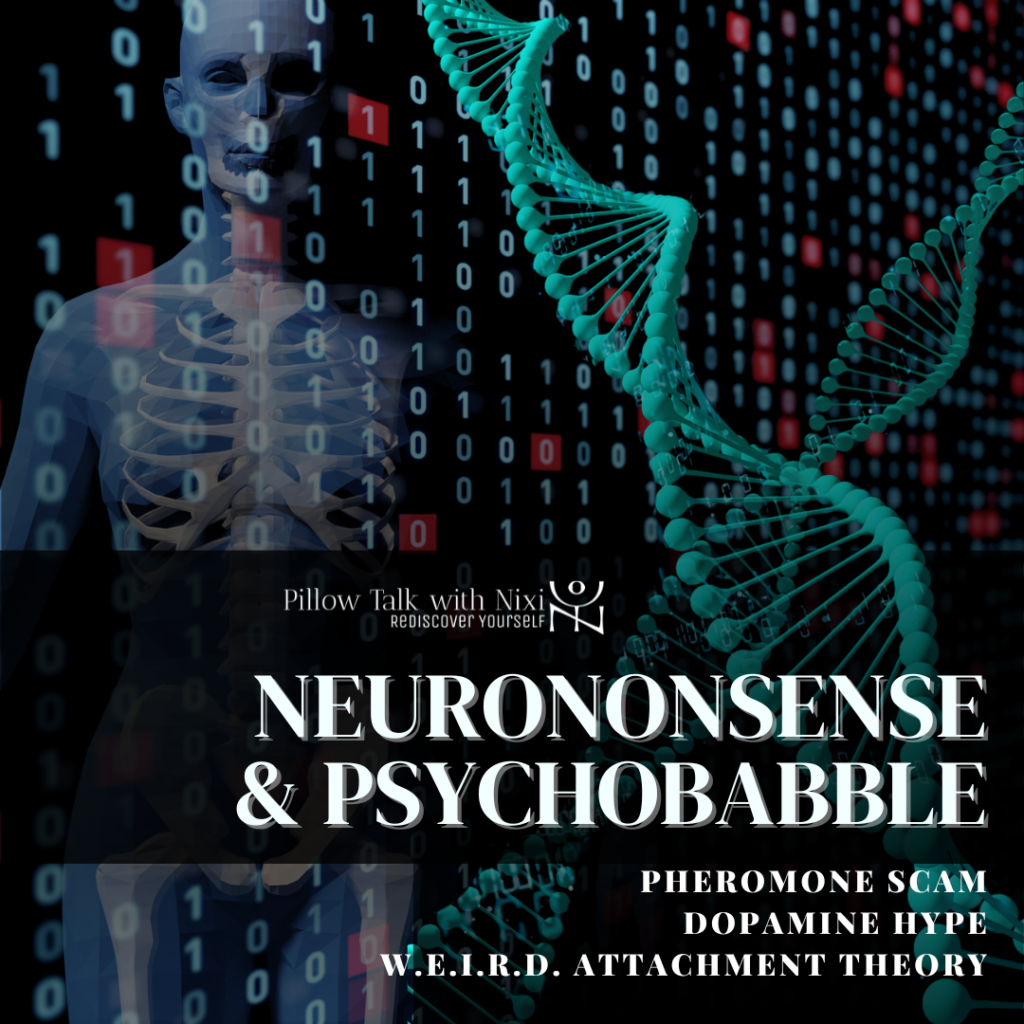
BIOPSYCHONEURAL NARRATIVES
[3 CE CREDIT HOURS]
AASECT CATEGORY
CKAs: A, B, C, E
EDUCATOR: Nishita Rao, CSE
WEBINAR [Synchronous/Virtual]
Distance Learning – Recordings available on The Elsewheres
DESCRIPTION
Are you ready to confront myths you may have encountered when delving into neuroscience and psychology? This session is a deconstruction in 3 parts, addressing pheromones, dopamine and attachment theory.
Do pheromones actually influence human attraction? The perfume industry would have you believe so. How dependent are we on pheromones? If not, then why do we have a $3.2bn Perfume Industry marketing us pheromones? If they do not exist then why do some smells seem attractive/repellent to us? We shall delve into the functioning of the Vomeronasal Organ (VNO) that is associated with pheromones. We will also explore the history of pheromone research, how our brain processes odors, and the neurochemical role of dopamine in attraction. The session will also dissect how the perfume industry capitalizes on these ideas of pheromone-driven attraction, offering participants a clearer understanding of the biology and neuromarketing.
When it comes to pleasure, the first hormone/neurotransmitter that comes to everyone’s mind is Dopamine. But what if I tell you Dopamine is not a Pleasure hormone. Let’s delve in into the world of Dopamine, its interaction with stimuli and the reward pathway.
Secure and insecure attachments were the foundations for much of modern psychological theories. However, increasing research suggest that theory can only applicable in Western societies. Come, delve into world of attachments, the underlying neurobiological circuits, and explore non-Western cultures as we test the theory’s validity.
LEARNING OBJECTIVES
- At the end of the session, attendees will be able to analyze the evolutionary and functional aspects of the vomeronasal organ (VNO) in humans and its significance.
- At the end of the session, attendees will be able to explore the neuroscience of reward systems and the role of dopamine in human behavior and consumerism.
- At the end of the session, attendees will be able to critically assess relevance of attachment theory in non-white, non-American and non-European cultures.
AVAILABLE ON
ErosCoaching AASECT CE · Standard Access Access Now The Elsewheres AASECT CE · Collective Access Access Now Forbidden Tickets Community Access Access Now Eventbrite Open Access Access Now Learn More about AASECT.
Access Key
Standard Access: Full course access with AASECT Continuing Education credits. Ideal for licensed clinicians and certified professionals fulfilling CE requirements (First-come, first-served).
Collective Access: Full course access with AASECT Continuing Education credits, offered at a lower price point to support decolonial participation across professional communities (First-come, first-served).
Community Access: Full course access without AASECT CE credits, designed for BIPOC, queer, kink+, and sex-positive community members engaging outside of a clinical or certification context.
Open Access: Registration open to all, including international students. No AASECT CE credits
EDUCATOR BIO

Nishita Rao (she/her) holds an MS in Neuroscience with a focus on Behavioral Neuroendocrinology and a BE in Biotechnology, specializing in Brain-Computer Interfaces & Phytochemistry. Her courses span across disciplines such as Sexual Sciences, Neuroscience, Anthropology, Molecular Biology, Behavioral Sciences, Political Science, Linguistics, Dance Ethnography, Ethnomusicology, and Paleoclimateology. She is also the First Indian AASECT Certified Sex Educator (CSE).