[3 CE CREDIT HOURS]
AASECT CATEGORY
CKAs: A, C, D
DESCRIPTION
How does the state define “women”? This course argues that womanhood (according to the state) is a socio-political construct produced to channel bodies into reproductive, economic, and social functions where they can be regulated. We map this production across three ontological stations of the reproductive axis of control: maiden, mother, and crone. Against this axis stands the “feral femme”: the figure who refuses domestication.
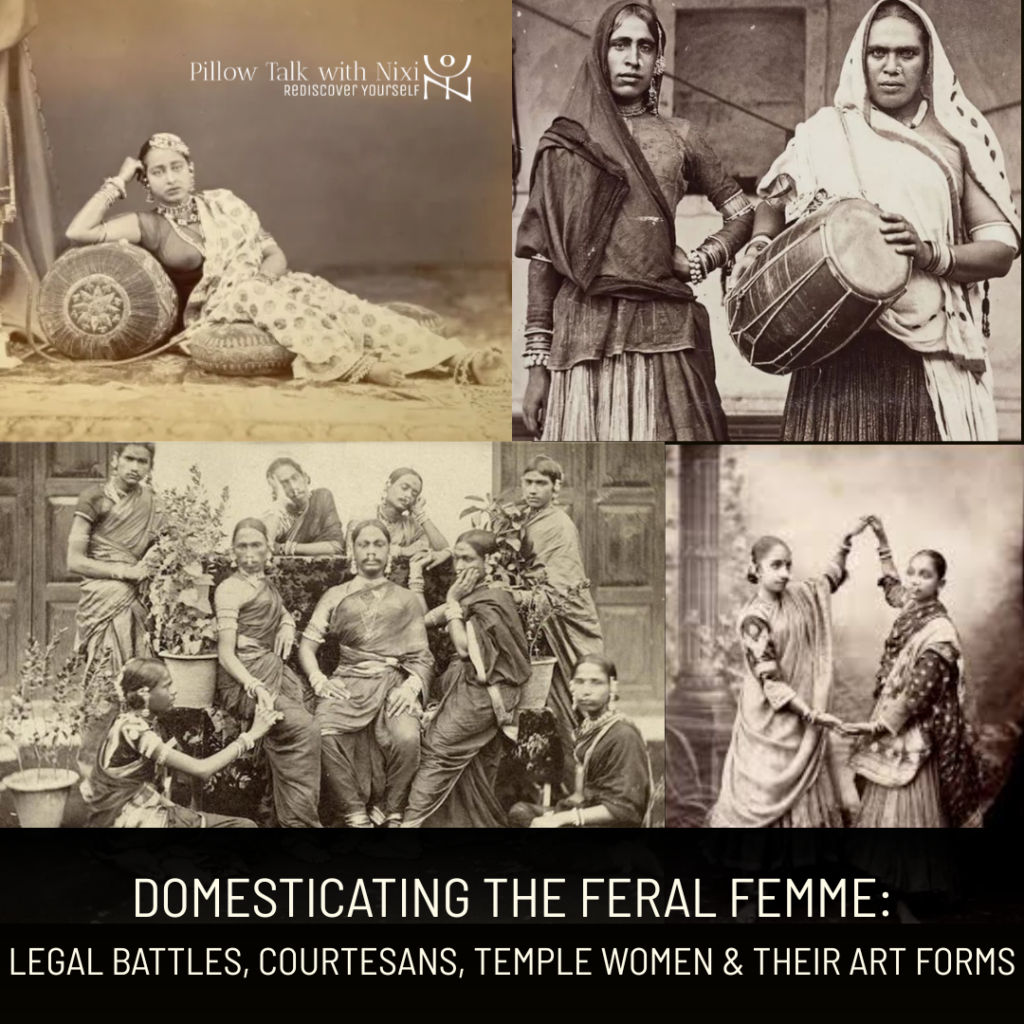
This course traces her across centuries. We encounter Gauhar Jaan (born Angelina Yeoward), an Armenian-Indian courtesan, who was the first woman and the first Indian artist to record a Gramophone Disc. We then travel light years to encounter the Golden Vinyl Record on the Voyager 1, launched by NASA in 1977, which carried the Sounds of the Earth. Amongst the selected sounds, a recording of yet another courtesan’s voice, Kesarbai Kerkar, floats in space today. As we await the aliens to discover our famous courtesans’ voices, we will then trailblaze through lived experiences of one of history’s superwomen, a courtesan of the name, Bangalore Nagarathnamma, and her predecessor, Muddupalani.
The course will investigate how the state attempted to domesticate the feral femme through cultural reform and legal battles. We shall explore how Victorian (British) modesty was imposed upon post-colonial bodies, replacing indigenous pluralities of vernacular sexualities. Finally, we deconstruct society’s modesty expectations through South Asian tales on fluidities in gender and sexualities, concluding with a parallel drawn between colonial India’s legal battles and social reform movements, with the rise in the world’s anti-gender and anti-sex worker policies.
LEARNING OBJECTIVES
- By the end of the session, attendees will be able to define the Reproductive Axis of Control and apply it to at least two historical case studies to analyze how womanhood is produced as a state instrument across the ontological stations of maiden, mother, and crone.
- By the end of the session, attendees will be able to analyze the social reform movement’s impact on the curbing femme autonomy.
- By the end of the session, attendees will be able to deconstruct at least two examples of “traditional” modesty norms in post-colonial societies, to trace their origins to colonial contact.
EDUCATOR BIO

Nishita Rao (she/her) holds an MS in Neuroscience with a focus on Behavioral Neuroendocrinology and a BE in Biotechnology, specializing in Brain-Computer Interfaces & Phytochemistry. Her courses span across disciplines such as Sexual Sciences, Neuroscience, Anthropology, Molecular Biology, Behavioral Sciences, Political Science, Linguistics, Dance Ethnography, Ethnomusicology, and more. She is also the First Indian AASECT Certified Sex Educator (CSE).