BIOPSYCHONEURAL NARRATIVES | FEMME ARCHITECTONICS | BIOPOLITICAL CARTOGRAPHY
[3 CE CREDIT HOURS]
AASECT CATEGORY
CKAs: C, D, E, F, M, N, P
DOI:
EDUCATOR: Nishita Rao, CSE
WEBINAR [Synchronous/Virtual]
DESCRIPTION
What is Love? Why do humans love? How many forms of Love do people talk about? Why do people defy for love, kill for love, die for love? Why can a Qawwali performance move a listener into Joy and Love that is so intense, it breaks into tears?
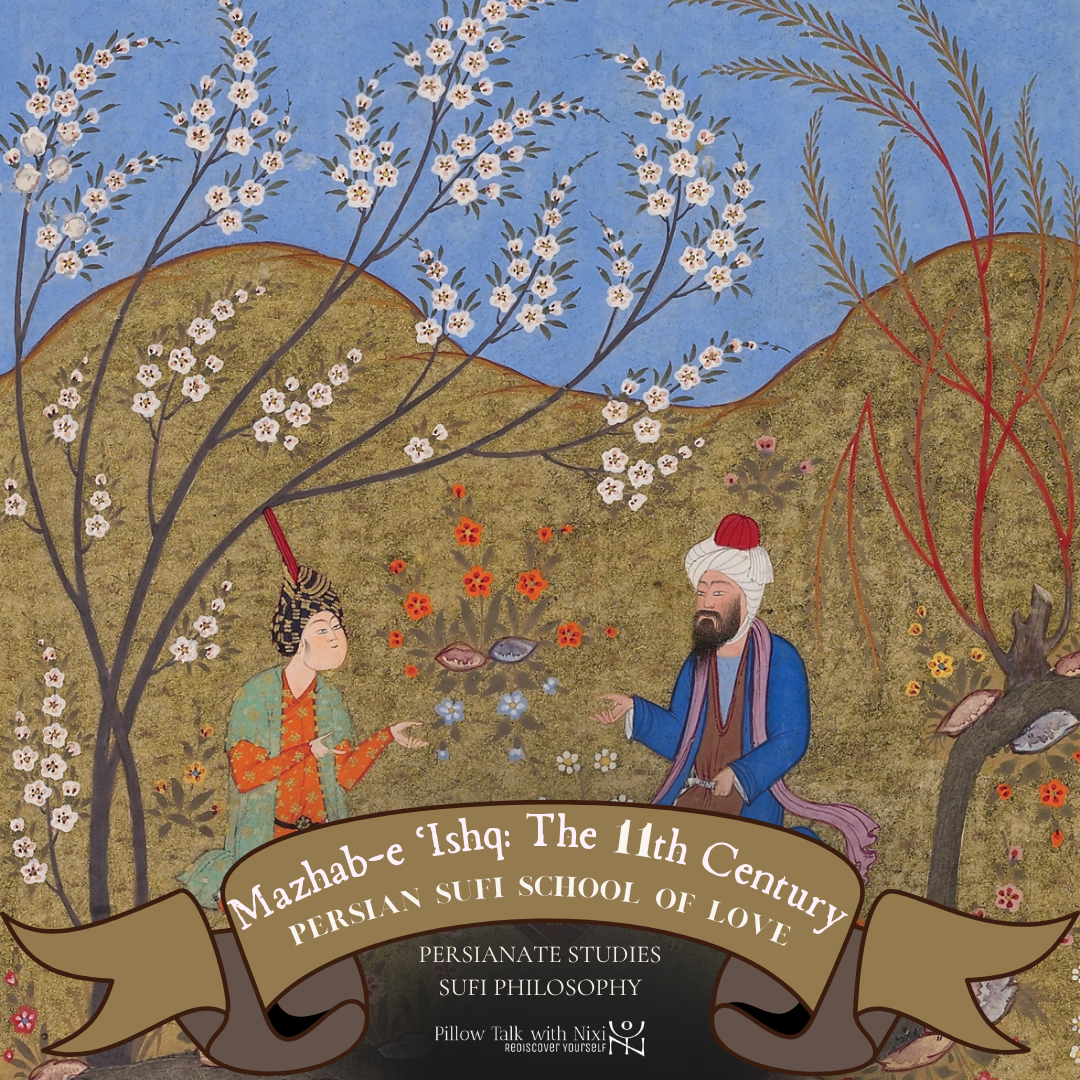
This session turns to Persianate Sufi tradition of The School/ Path of Love (Mazhab-e ‘Ishq). Omid Safi memorably names this current the “path of radical love”. To borrow the language of trinity, in this Path of Radical Love, the Lover, the Beloved and Love itself are treated as the trinity. In this lineage, ‘ishq is not a private feeling or a moral slogan; it is a metaphysical force that remakes the lover, and (in some formulations) the very reality of lover and beloved. We’ll ground the discussion in Ahmad al-Ghazālī’s Sawāniḥ al-‘Ushshāq (The Lover’s Experiences), one of the earliest sustained Sufi treatises on love, and we’ll listen to Qawwali as a living vernacular of these ideas: the tension between ‘ishq-e ḥaqīqī (love of the Real) and ‘ishq-e majāzī (love in forms), the burning logic of longing, and the strange possibility that distance is not the failure of love but its native condition.
We will also explore Love as described in Qawwali: Ishq-e-Haqeeqi and Ishq-e-Majazi. The former is the supreme Sufi concept of absolute, selfless love for God (Allah), regarded as the only true and worthy love. It signifies shifting devotion from the latter, temporary, physical world to the eternal Creator, aiming for spiritual purification, self-annihilation (fana), and ultimately, union with the Divine. Join me as I discuss the foundational text of this school, Aḥmad al-Ghazālī’s Sawāniḥ al-‘Ushshāq (The Lover’s Experiences), the first Persian Sufi treatise on love. This influenced 11th century Bhakti movements in India, and resonates strongly with the phenomenology of Fictosexual desires for romance, love, kink and sex with Gods [which will be the highlight of the next class].
LEARNING OBJECTIVES
- By the end of the session, attendees will be able to contextualize and employ fictosexual resonances as a methodology to read works from pre-modern societies.
- By the end of the session, attendees will be able to understand how love and desire get organized and expressed towards a beloved.
- By the end of the session, attendees will be able to examine the role of Fort William College in transforming the love expressed in Mazhab-e ‘Ishq.
EDUCATOR BIO

Nishita Rao (she/her) holds an MS in Neuroscience with a focus on Behavioral Neuroendocrinology and a BE in Biotechnology, specializing in Brain-Computer Interfaces & Phytochemistry. Her courses span across disciplines such as Sexual Sciences, Neuroscience, Anthropology, Molecular Biology, Behavioral Sciences, Political Science, Linguistics, Dance Ethnography, Ethnomusicology, and Paleoclimateology. She is also the First Indian AASECT Certified Sex Educator (CSE). She is also a Reiki Grandmaster.